What Is Claude Mythos? Why Anthropic Won't Release It Publicly
For / Key Points
For: Developers tracking Claude's roadmap / Engineers interested in AI and cybersecurity / Readers who want a grounded, non-hyped reading of Anthropic's announcement
Key Points:
- Claude Mythos Preview is not a general-release model. It is a research preview distributed only for defensive use.12
- Anthropic's reason for not releasing it is fairly simple: its cyber capability appears strong enough to be dangerous if widely distributed.12
- What matters for most developers is not Mythos access itself, but how Mythos-era lessons will flow back into future Opus and Claude Code safeguards.1
Claude Mythos, in one line, is the Claude model Anthropic considers too strong to release publicly. On April 7, 2026, Anthropic announced it alongside Project Glasswing, but did not position it as the next Claude that everyone would get to use.1
The reason is direct. Anthropic says the model showed cyber capability strong enough to create obvious dual-use risk: valuable for defense, but risky if handed to malicious users.23 That is the center of the story.
The question for this article is simple: what is Claude Mythos, why was it held back, and what should developers pay attention to instead?
1. Start with the Core Point: Mythos Is Not a Public Claude Release
First, fix the positioning.
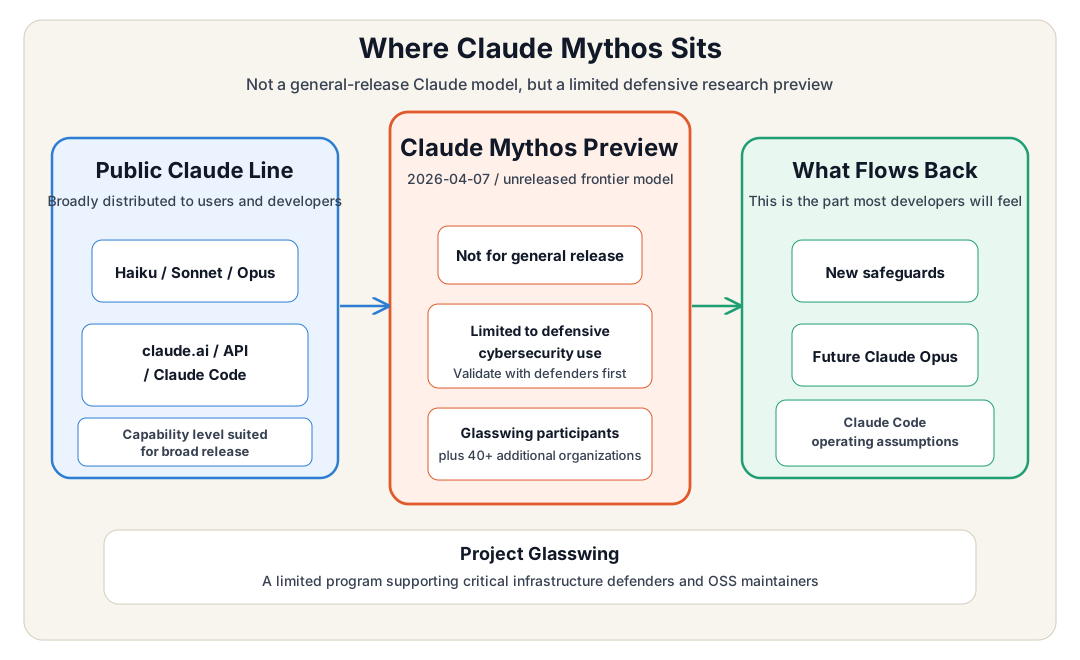
Mythos is not in the same category as Haiku, Sonnet, or Opus. Anthropic describes it as a defensive research preview distributed under a limited program rather than as a model intended for broad public use.12
Three facts matter most.
- Announcement date: April 7, 2026. It was announced together with
Project Glasswing.1 - Distribution is limited. Access is centered on Glasswing participants and more than 40 additional organizations.1
- There is no current plan for general release. Anthropic states that directly.12
So if you read Mythos as "the next Claude that will soon be broadly available," you are reading the announcement the wrong way. The more accurate frame is: a dangerous-capability model being used first in a constrained defensive setting.
If you want the public-release baseline first, Claude Opus 4.6 Complete Guide is the right comparison point. Mythos is on the same frontier curve, but under a very different distribution policy.
2. Why Anthropic Is Not Releasing It
The answer is not abstract. Its hacking-relevant capability appears too strong.
Anthropic's system card places cyber capability at the center of the non-release decision.2 The company says the model showed the ability to find and exploit zero-day vulnerabilities in major operating systems and web browsers. That is highly valuable in defensive security work, but it is also the kind of capability that becomes dangerous if widely deployed to unknown users.123
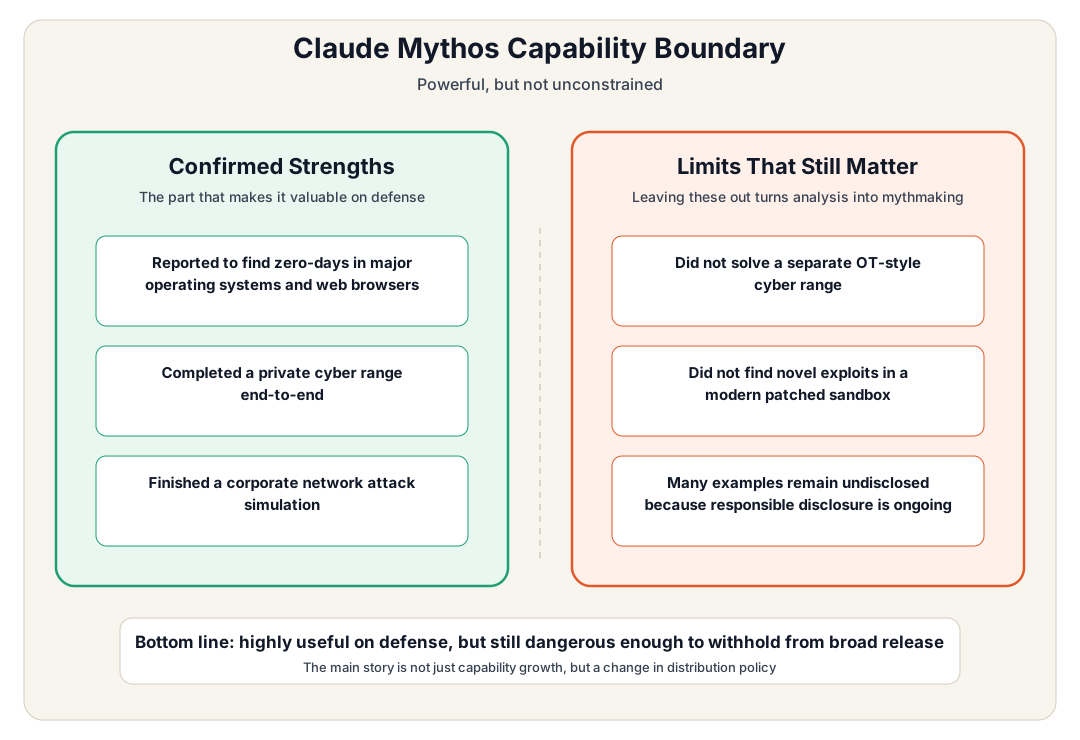
The important nuance is that Anthropic does not present Mythos as magical or unconstrained.
- Confirmed strengths: It completed a private cyber range end-to-end and finished a corporate network attack simulation.2
- Remaining limits: It did not solve a separate OT-style cyber range, and it did not find novel exploits in a properly configured, modern patched sandbox.2
- Why it was still held back: Even with those limits, the capability was strong enough to create obvious attack-side transfer risk.12
Some secondary coverage drifted toward more exotic interpretations. The primary-source reading is simpler. Anthropic held Mythos back because of cyber risk, not because of a vague or symbolic concern.2
3. How Strong Does It Look?
On benchmarks, Mythos does not look like a mild step up from Opus 4.6. The gap is large across coding, reasoning, and computer-use tasks.12
| Benchmark | Mythos Preview | Opus 4.6 | How to read it |
|---|---|---|---|
| SWE-bench Verified | 93.9% | 80.8% | Realistic software-fix tasks12 |
| SWE-bench Pro | 77.8% | 53.4% | Harder public benchmark set12 |
| Terminal-Bench 2.0 | 82.0% | 65.4% | Terminal execution and agent completion12 |
| GPQA Diamond | 94.6% | 91.3% | High-difficulty reasoning12 |
| Humanity's Last Exam | 64.7% with tools | 53.1% with tools | Broad academic and knowledge reasoning12 |
| OSWorld-Verified | 79.6% | 72.7% | Computer use including GUI workflows12 |
But the key point is not just that the scores are high. Anthropic did not hold the model back because it was generally smarter in the abstract. The concern is that the strength appears in a form that maps directly onto offensive cyber scenarios.
The red-team report reinforces that point. Anthropic says it is responsibly disclosing thousands of additional high and critical vulnerabilities.3 This is not just a benchmark headline. It is about practical discovery capability.
4. What Developers Should Watch Instead
For most developers, the most important question is not, "When do I get Mythos access?" It is what changes downstream from Mythos.
- Safeguards will likely strengthen first. Anthropic says new safeguards refined through Glasswing work will be reflected in future Claude Opus releases.1
- Permission design matters more. If stronger models are the baseline, protecting systems by prompt wording alone becomes weaker than structural isolation of secrets and execution scope.
- Claude Code operations will keep shifting. The more capable the model, the more important it becomes to define what it can touch, what it cannot touch, and where it must stop.
That is why Mythos is better understood as an operating-policy example for dangerous frontier capability, not as a teaser for a consumer-facing model launch. It connects naturally to the questions in What Is Anthropic Managed Agents?: isolation, harness design, and how to make stronger agents safe to run.
Summary
Claude Mythos is not Anthropic's next public Claude release. It is a limited research preview created under a very specific judgment: too risky to distribute broadly, but too useful on defense to ignore.12
The bigger implication is that the release pattern for frontier models may be changing. Instead of pushing the strongest capability directly into broad availability, labs may first run it in constrained defensive programs, harden the safeguards, and then send only the safer lessons back into public models. That is a shift from "ship the capability first" toward "stabilize the safeguards first."
So the practical thing to watch is not Mythos access itself. It is which Mythos-level safety assumptions begin to appear in future Opus releases and in Claude Code's operating model. That is where the real downstream impact lands.
Related Articles
- Claude Opus 4.6 Complete Guide — The public-release baseline that Mythos should be compared against
- Claude Code Security Announcement Summary — A parallel line on defense-side tooling and security posture
- What Is Anthropic Managed Agents? — How stronger models connect to isolation and runtime design